Features · Integrated Education Harness

The harness for course design.

ChatGPT, Claude, Codex, and Gemini are powerful models—and Egora integrates them directly inside the structure of teaching, with education-grade privacy and you deciding what’s final.

01 · Plan

Lex, a course-design partner

Lex starts the way a good colleague would: by asking about your learners, your goals, and what you want to see them do. It proposes a plan for you to shape, and you can review a full plan before anything is built.

  • Asks the questions that matter before drafting
  • Uses Learning by Design and backward assessment when the work reaches them
  • Challenges and scaffolds; every teaching decision stays yours

02 · Build

A real course, not a chat log

Units, modules, lessons, and materials live in your course contents. Every save is a new version you can restore, your sources stay attached, and the course remembers where you left off teaching.

  • Lesson guides, slides, handouts, and rubrics saved under the lesson
  • Version history and restore on every document
  • Teaching progress: continue teaching, notes for next time

03 · Decide

You decide what’s final

Saved, reviewed, approved, and published are separate steps in Egora. A review checks drafts against the decisions you recorded, and anything that needs your judgement comes back to you as a note or a to-do.

  • A draft is never treated as approved
  • Reviews check work against your recorded decisions
  • Nothing is published until you choose

Classroom-ready publishing

Actual slides, lesson guides, handouts, and rubrics—ready for your room

Every artifact in your course tree exports directly to self-contained HTML slide decks, Google Docs, Google Slides, Google Sheets, Microsoft Word, PowerPoint, or print-ready PDF.

Self-contained HTML Slide Deck· offline-readyGoogle Slides & PowerPointGoogle Docs & Microsoft WordGoogle Sheets· 4-point rubricsPrint-ready PDF
[Unit 1 · Worldviews & Networks]Slide 02 / 18 · Vellum

Slide 1.1 · Two Maps, One Earth

01 · 12th-C. European T-O Map

East oriented at the top toward Eden; Jerusalem placed at the physical center of the Christian cosmos.

02 · Tabula Rogeriana (1154 CE)

Drawn by Muhammad al-Idrisi with South at the top, Mecca centered, and detailed Indian Ocean coastlines.

Facilitator note: “Neither map is a failed attempt at Google Maps—each is drawn through the lens of what its culture valued most.”
Session 4 · Interrogating TraveloguesSlide 11 / 18 · Blue Pro

Slide 4.2 · 5-Step Source Interrogation

STEP 01 · ORIGIN

Who & Where

Who wrote it, when, and what was their social rank?

STEP 02 · PURPOSE

Audience & Patron

Why was it recorded and who funded the journey?

STEP 03 · LENS [W]

Worldview Values

What beliefs shaped what they praised or judged?

STEP 04 · SILENCES [?]

Missing Voices

Whose perspectives (women, non-elites) are absent?

Applied in studio: Xuanzang in Samarkand (646 CE), Ibn Battuta in Delhi (1355 CE), and Miwnay’s Sogdian Letter (313 CE).
units/unit-1/lessons/week-1-foundations.mdLesson Plan Document

Week 1 Teacher Facilitation & Lesson Guide: Foundations of Worldview & Afro-Eurasian Networks

Course: Grade 8 Social Studies (BC Curriculum)
Unit 1: Worldviews & Interconnected Networks (ca. 7th–14th C.)
Framework: Workshop Model (8m Hook · 12m Mini-Lesson · 25m Studio · 10m Debrief)
Summative Target: Worldview Crossroads Exhibition (Milestone 1)

1. Session 1: The Lenses We Wear — Deconstructing Worldview

  • Hook & Framing (8 mins): Display a 12th-century European T-O Map alongside Muhammad al-Idrisi’s 1154 Tabula Rogeriana. Ask: “What does the center and top of each map reveal about what each society valued most?”
  • Targeted Mini-Lesson (12 mins): The Cultural Iceberg (10% visible surface culture vs. 90% deep worldview across 6 dimensions: Knowledge, Authority, Nature, Hierarchy, Cultural Others, Time) & Warning Against Presentism.
  • Workshop Studio (25 mins): In pairs, students analyze medieval European and Song Dynasty scenario cards to identify underlying worldview dimensions without “2026 glasses.”
Misconception Alert — “The Silk Road was a single paved highway”: Clarify that it was an ever-shifting 7,000 km relay web of oasis trails, mountain passes (Pamirs), and monsoon sea lanes where few merchants ever traveled end-to-end.
units/unit-1/resources/primary-source-packet.mdStudent Handout Document

Primary Source Packet: Voices of the Crossroads (ca. 4th–14th C.)

Name ____________________________________Date ____________________

Source 1. Ibn Battuta at the Court of Delhi (ca. 1355 CE)

Historical Headnote: Abu Abdallah Muhammad Ibn Battuta (1304–1369 CE), a Moroccan Islamic legal scholar (qadi), traveled 117,000 km across Afro-Eurasia and served at the court of Sultan Muhammad bin Tughluq in Delhi.

[07]When foreign scholars, merchants, or diplomats arrive at his court, he presents them with thousands of gold dinars, fine Arabian horses, and robes of embroidered silk (khil’a) brought from China and Persia…

[14]One day, while I was serving as qadi, a Hindu merchant came before the Sultan’s legal assembly accusing the Sultan himself of withholding money owed for horses bought by the royal army.

[16]The Sultan walked on foot into the court without his imperial guard, bowed before the qadi, and said: ‘Judge between us with truth, according to the Law, and do not favor me because I am sovereign.’

Margin Glossary

Dinar (07): High-value medieval Islamic gold coin used in international trade.

Khil’a (08): Embroidered silk robe of honor gifted by rulers to allies.

Qadi (14): A judge who interprets and administers Islamic law (sharia).

units/unit-1/project-brief.mdAssessment & 4-Point Rubric

Project Brief & Rubric: The Worldview Crossroads Exhibition (ca. 7th–14th C.)

BC Curricular CompetencyEmergingDevelopingProficient (Target)Extending
Evaluating Historical Evidence & SourcesIdentifies basic facts with assistance; reads literally.Identifies author, date & topic; notes obvious bias.Analyzes origin, purpose, worldview lens & missing voices with citations.Synthesizes conflicting sources; interrogates historical silences.
Analyzing Perspectives & WorldviewsJudges past societies using modern 2026 standards (presentism).Compares surface features (food, dress) rather than deep beliefs.Completes nuanced Worldview Matrix across Knowledge, Authority, Nature & Others.Explains internal tensions within civilizations & long-term shifts.

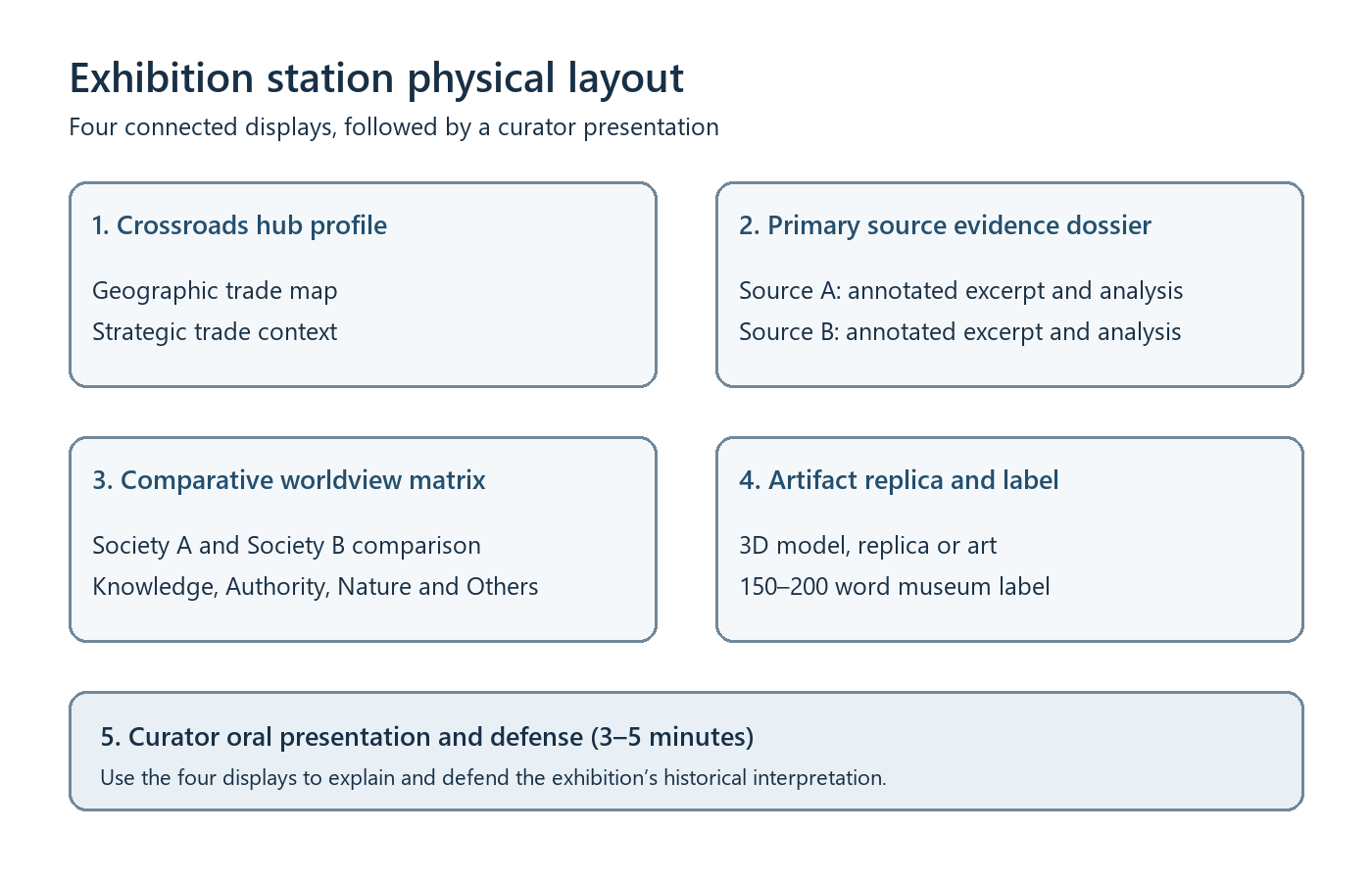
Committed Course Figure · units/unit-1/images/exhibition-station-layout.png

Exhibition station physical layout: 1. Crossroads hub profile, 2. Primary source evidence dossier, 3. Comparative worldview matrix, 4. Artifact replica and label, 5. Curator oral presentation

Multimodal knowledge base

Everything you teach from, in one private place

Upload documents, slides, primary sources, images, audio, and video, or save an official curriculum web page. Egora reads, transcribes, or describes each one, makes it searchable, and cites it directly in the lessons you build.

Every format you use in class

PDF, Word, PowerPoint with speaker notes and chart data, spreadsheets, photos, recordings, and video.

Diagrams and photos become figures

Visuals inside your documents—like exhibition layouts or historical maps—are kept as captioned figures ready to place straight into a lesson or slide.

Official curriculum, word for word

Curriculum pages are saved as source snapshots, so BC Big Ideas and Curricular Competencies keep their exact wording.

Cited down to the page, line, or slide

Lex quotes your sources and links back to them—so you never have to guess where a historical claim or rubric criterion came from.

Memory and personalization you control

Specialize the system to the way you teach.

Your teaching approach, assessment habits, slide style, and non-negotiables shape every class once you approve them—and even connect to Codex when you grant access. You can view, correct, export, or forget any memory at any time.

For every classroom you teach

One curriculum spine, adapted for each group

Build your core unit once, then create materials for each block, reading level, or accommodation without starting over.

K–12 · Multi-section prep

Science 9 · Periods 2 & 4

Build one core unit, then adapt reading levels, lab scaffolds, and exit tickets for each block without starting over.

Lesson guide · Slides · 2 handouts

Higher education

Environmental Policy 201

Turn primary readings and course outcomes into discussion guides, case packets, and aligned grading rubrics.

Seminar guide · Case packet · Rubric

Inclusion & differentiation

Learning Support & ELL

Generate visual organizers, vocabulary anchors, and UDL scaffolds built from the main classroom lesson and saved beside it.

Visual model · Vocabulary sheet

Independent educators

Applied Design Cohort

Go from domain expertise to structured modules, slide decks, and participant workbooks you own outright.

Workshop deck · Facilitator notes

And everything around it

Built for the work of teaching

Grounded in your curriculum, ready for your classroom tools, and shaped by how you teach.

Curriculum-grounded, framework-agnostic

Reads official curriculum, such as British Columbia’s, from the source and keeps its exact wording and codes—or works from your own goals. UDL, the First Peoples Principles of Learning, or Learning by Design apply only when you choose them.

A multimodal knowledge base

Upload PDF, Word, PowerPoint, spreadsheets, images, audio, and video, or save a web page. Each is read, transcribed, or described, made searchable, and cited in the lessons that use it. Lex can also generate images for slides and save them to your course.

Publish with templates

Choose a document type (lesson plan, unit outline, student handout, assessment and rubric) and a design (Executive, Modern, or Academic). Publish to Google Docs, Slides with card layouts and embedded videos, and Sheets for rubrics, or download Word, PowerPoint, and PDF.

Preferences and memory you control

Your approach, assessment habits, style, and lesson non-negotiables, drafted with Lex and approved by you, shape every class. Memory keeps only what you choose, and you can correct, export, or forget it.

Differentiation from one plan

Adapted handouts, scaffolds, and extensions for different sections or learners, written from the same lesson and saved beside it.

Integrates Gemini, Claude, ChatGPT & Codex

Runs on Google Gemini by default and integrates Claude and ChatGPT (GPT) models through model routing. OpenAI Codex can connect directly to your Egora memory with time-limited access.

Privacy, integration & classroom focus

Why not just use ChatGPT, Claude, or Codex?

Consumer AI platforms retain access to what you paste into them and leave you to build the teaching structure yourself. Egora integrates those frontier models inside a private, teacher-owned course workspace.

Privacy & who accesses your dataEducation privacy first
Consumer ChatGPT, Claude & CodexEverything you paste or upload into standard consumer chat or agent sessions goes directly into commercial platforms that retain access to your prompts, files, and classroom context—outside school privacy boundaries.
Egora · Integrated Education HarnessPrivate by design. Integrates Gemini, Claude, ChatGPT (GPT), and Codex inside a protected educator boundary: zero student accounts or identifiable student records, no training public models on your work, and full ownership of your files.
Integrating ChatGPT, Claude, Codex & GeminiMulti-model harness
Consumer ChatGPT, Claude & CodexSeparate subscriptions and isolated workspaces. Switching between ChatGPT, Claude, Gemini, or Codex means re-explaining your course and losing context.
Egora · Integrated Education HarnessIntegrates them in one education harness. Run on Gemini, route through Claude and ChatGPT (GPT) models, and connect Codex directly to your Egora teaching memory with time-limited access.
Multiple classroom adaptations1 spine → 4 sections
Consumer ChatGPT, Claude & CodexEvery reading level, section block, or IEP/ELL accommodation requires re-prompting from scratch and quickly drifts out of alignment.
Egora · Integrated Education HarnessOne curriculum spine, adapted in minutes. Build your core lesson once and generate bespoke versions for Period 2, Period 4, ELL, and learning support saved right beside the original.
Finding & reusing files next termVersioned course tree
Consumer ChatGPT, Claude & CodexYour best lessons get buried inside endless scrolling chat histories or scattered across loose folders you have to organize yourself.
Egora · Integrated Education HarnessVersioned course files. Every lesson guide, slide deck, handout, and rubric lives in your course table of contents with full revision history and instant retrieval.
Teaching memory & personalizationTeacher-approved only
Consumer ChatGPT, Claude & CodexGeneric consumer memory across unrelated personal tasks, with no structured teaching profile or school-scoped boundaries.
Egora · Integrated Education HarnessEducator-approved memory. Remembers your teaching approach, pacing routines, and lesson non-negotiables only when you approve them—and lets you view, edit, export, or forget them anytime.
Review, approval & publishingOne-click export
Consumer ChatGPT, Claude & CodexRaw text to copy-paste and reformat by hand, or agent edits that land directly in your files without a formal teacher review step.
Egora · Integrated Education HarnessSaved, reviewed, approved, and published are separate. Publish approved versions directly to Google Docs, Slides, and Sheets, or download Word, PowerPoint, and PDF.

Privacy and ownership

Your content, your control

Built for educator authoring, without student accounts or identifiable student records. Every file you create is yours to keep and export.

Protected classroom boundaries

Our launch requirements exclude the sale of personal information, targeted advertising, and training public AI models on your course materials or conversations. Connections to Figma and Canva are read-only and start from your consent, and Egora’s agents never get a shell on your system.

Memory you can see and change

Egora remembers only what you choose to keep about your teaching. You can see, correct, export, or forget it at any time, and nothing is learned from your conversations automatically.

Pre-launch overview: provider details and controls are being finalized before launch. Read the privacy overview →

Questions

Frequently asked questions

How Egora integrates ChatGPT, Claude, Codex, and Gemini inside a private, teacher-owned classroom workspace.

Why not just use ChatGPT, Claude, or Codex directly?
When you paste lesson plans or upload files into standard consumer ChatGPT, Claude, or Codex sessions, those commercial platforms retain access to your prompts and data—and they leave you to organize files, manage versions, and re-prompt for every classroom adaptation. Egora integrates Gemini, Claude, ChatGPT (GPT), and Codex inside a private, educator-owned harness: grounding drafts in official curriculum, saving every lesson, slide deck, handout, and rubric as versioned course files, and keeping drafts separate from what you approve.
How does Egora integrate Gemini, Claude, ChatGPT, and Codex?
Egora runs on Google Gemini by default, can route work through Claude and ChatGPT (GPT) frontier models, and lets OpenAI Codex connect directly to your Egora teaching memory with time-limited access—so you get the frontier AI you already use inside a workspace built specifically for teaching.
How does Egora help when I’m prepping multiple classroom adaptations?
Teacher time has never been pushed harder. In Egora, you build a core unit or lesson once, then generate adapted reading levels, IEP/ELL scaffolds, lab extensions, and section-specific handouts (like Period 2 vs. Period 4) built from the same lesson and saved right beside it.
Can I start from a rough intent, or go straight from an idea to documents?
Both. If you have a rough teaching intent, Lex acts as a thought partner—asking sharp questions and helping you shape a unit arc. If you already have an idea, Egora takes care of the scaffolding to draft classroom-ready Google Docs, Slides, Sheets, Word documents, PowerPoints, and PDFs.
How does Egora remember how I teach without learning behind my back?
Two ways, both under your explicit control. Teaching preferences hold your approach, assessment habits, style, and lesson non-negotiables; Lex drafts them with you, and once you approve them they shape every class. Memory keeps only what you choose to save for a course or your workspace, and you can view, correct, export, or forget it anytime.
Do I own the materials I create, and how is privacy protected?
Yes. Every lesson, slide deck, worksheet, and rubric you create is yours to export cleanly. Egora’s initial release is built for educator authoring—with no student accounts or identifiable student records required—and our launch requirements exclude selling personal data, targeted advertising, and training public AI models on your course materials.Read our education privacy overview →
Is Egora meant to replace teachers?
Never. Egora is built for educators, by educators. It is designed to guide you, challenge your thinking, and take care of the time-consuming scaffolding—while every pedagogical judgment and final approval stays in your hands.

Educator pilot

Help shape the frontier of teacher-led learning.

We’re inviting a small group of educators to build real courses with Egora before launch, tell us what works, and reclaim their prep time—without giving up ownership of their craft.

Pilot sign-up opens soon.